


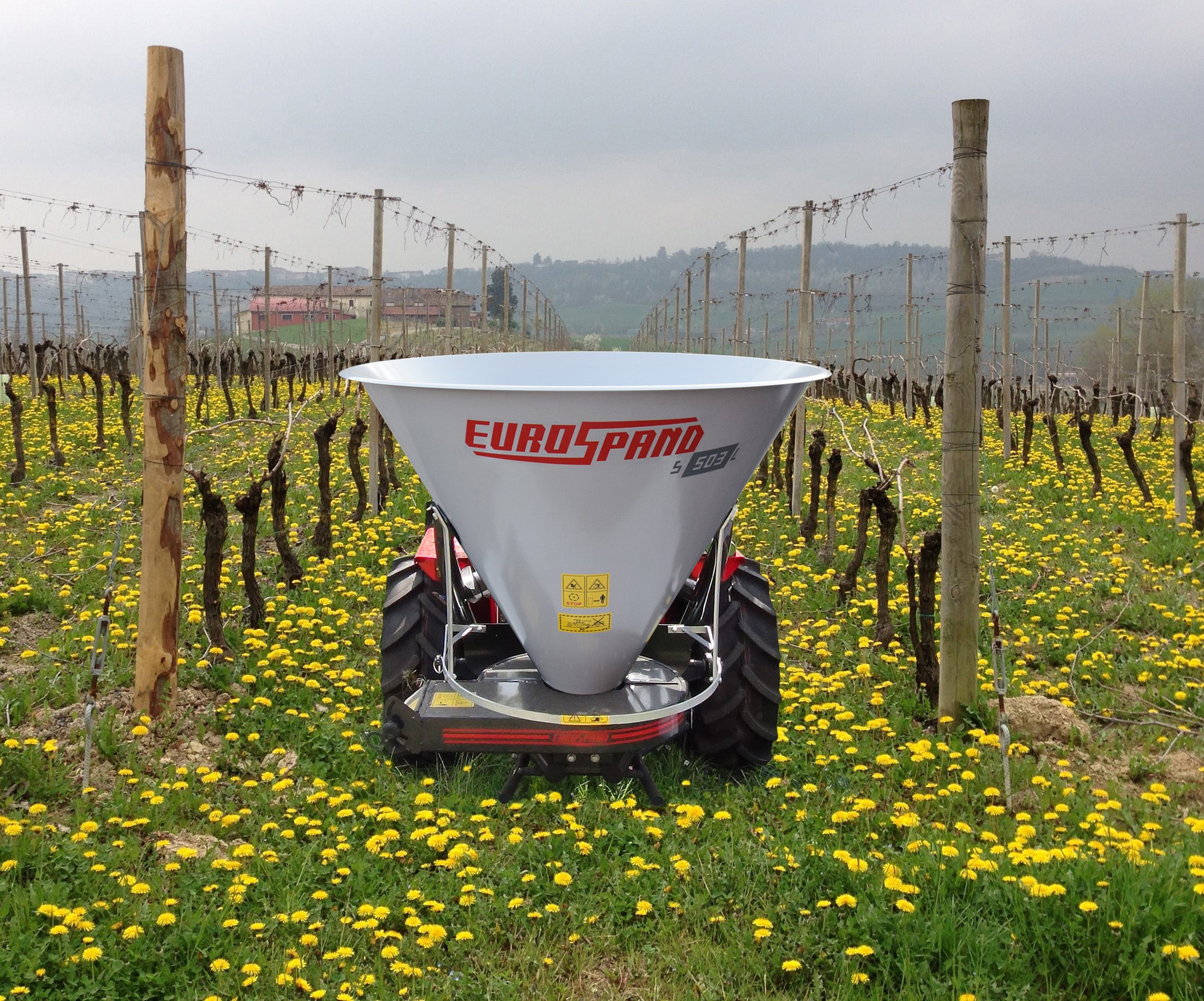
For a small farm, an experienced hobby farmer, or anyone managing fragmented plots, choosing a fertilizer spreader often comes down to one question: “Do I really need a large and complex machine?”
Choosing a single-disc fertilizer spreader does not mean settling for a less efficient machine. On the contrary, it means choosing a machine that is properly sized for the tractor, the actual area to be treated and, above all, the manoeuvrability required in confined spaces.
The cornerstone of our production philosophy is simple: you do not always need a twin-disc spreader. In many operating conditions — small orchards and vineyards, professional market gardens or green-space maintenance — a well-built single-disc spreader delivers excellent spreading accuracy while requiring only a fraction of the space and maintenance of larger machines.
In the Eurospand range, the comparison between the S503L and 733R models perfectly represents this choice: on one side, the extreme compactness of the SL range; on the other, the proven robustness of a model that has played an important role in the history of agricultural mechanization in many countries around the world.
The risk of oversizing: why bigger is not always better
One of the most common mistakes when choosing equipment is to focus exclusively on hopper capacity. It is a logical trap: “If the hopper is larger, I will finish sooner.” In theory, this is true; in practice, it often isn’t.
If the tractor being used has low power or a narrow track width, an oversized machine can create structural and operational risks:
- Front axle imbalance: excessive weight on the three-point linkage lightens the front axle, making steering less precise and potentially dangerous.
- Soil compaction: entering the field with unnecessary weight damages soil structure, especially in wet conditions.
- Reduced manoeuvrability: in orchards or hilly areas, every centimetre of overall width matters. A machine that is too wide or too tall can make headland turns unnecessarily difficult.
- Excess product remaining in the hopper: on small plots, having to deal with large quantities of fertilizer left in an oversized hopper makes emptying and cleaning more complicated.
For this reason, the first Eurospand selection criterion is not “how much does it hold?”, but rather “how efficiently does it work in my actual operating conditions?”.
S503L: precision designed for small areas
The S503L is the largest model in our SL range. With a capacity of 360 litres, it has been specifically designed for users with lightweight tractors, equipped with a Category I three-point hitch, who need a machine that almost disappears behind the tractor profile.
Despite its compact dimensions, we make no compromises on quality. The SL range is built according to rigorous CE standards and offers straightforward adjustment, making it ideal for hobby farmers who do not want to spend hours dealing with complicated calibration procedures.
When to choose the S503L
- Compact or articulated tractors: the three-point linkage is not excessively loaded and stability is maintained.
- Compact or articulated tractors: the three-point linkage is not excessively loaded and stability is maintained.
- Frequent but light fertilization: ideal if your agronomic strategy involves applying small amounts of nutrients at regular intervals.
- Easy storage: it takes up very little space in the shed and is extremely easy to clean at the end of the working day.
Choosing a 733R, on the other hand, means investing in a machine that will retain its value over time and can continue to meet the needs of the farm if the cultivated area increases moderately.
The chemical challenge: why stainless steel matters
Whether we are talking about the compact S503L or the robust 733R, Eurospand pays close attention to the materials used. Modern fertilizers contain highly aggressive chemical compounds. In the presence of moisture, nitrates can trigger extremely rapid corrosion processes that can literally eat away at the metal of low-cost machines within just a few seasons.
Why is this not merely an aesthetic issue, but a technical one?
If the dosing shutters or spreading disc corrode, their surfaces become rough and irregular. This changes the fertilizer’s friction characteristics, resulting in:
- Irregular application rates: the amount discharged is no longer the amount that was originally set.
- Asymmetrical spreading patterns: more fertilizer falls on one side than the other.
The use of stainless steel in Eurospand components ensures that the geometry of the outlet openings remains accurate over time, helping ensure that every kilogram of fertilizer ends up exactly where it should.
Choosing the right model: three questions to avoid making the wrong choice
To help you decide between the S503L and the 733R, ask yourself these three questions:
- What is the lifting capacity of my tractor? If you are working with a 20–30 hp tractor, the S503L is the natural choice for safe operation. If you have a 50–70 hp tractor, the 733R allows you to make better use of the machine’s available power.
- Will I be spreading fertilizer on flat ground or on slopes? On hills, weight is your worst enemy. A lighter machine such as the S503L lowers the centre of gravity and reduces the risk of overturning.
- What is my long-term budget? If you are looking for a competitive entry price without compromising on quality, the S503L is hard to beat. If, on the other hand, you see the fertilizer spreader as a long-term investment that needs to last twenty years even under demanding conditions, the reinforced structure of the 733R will more than justify the price difference.
Efficiency comes from the right balance
There is no single “best fertilizer spreader”. There is only the machine that is right for your specific operating conditions. Since 1970, Eurospand has been designing agricultural machinery by listening to the people who work the land every day.
Whether you choose the technological compactness of the S503L or the legendary robustness of the 733R, you can rely on accurate spreading, solid construction and technical support from a team that knows every single bolt of your machine.
To learn more about the technical specifications and consult the spreading charts, visit the dedicated SL range section on eurospand.com or contact your nearest authorized dealer for personalized advice.