


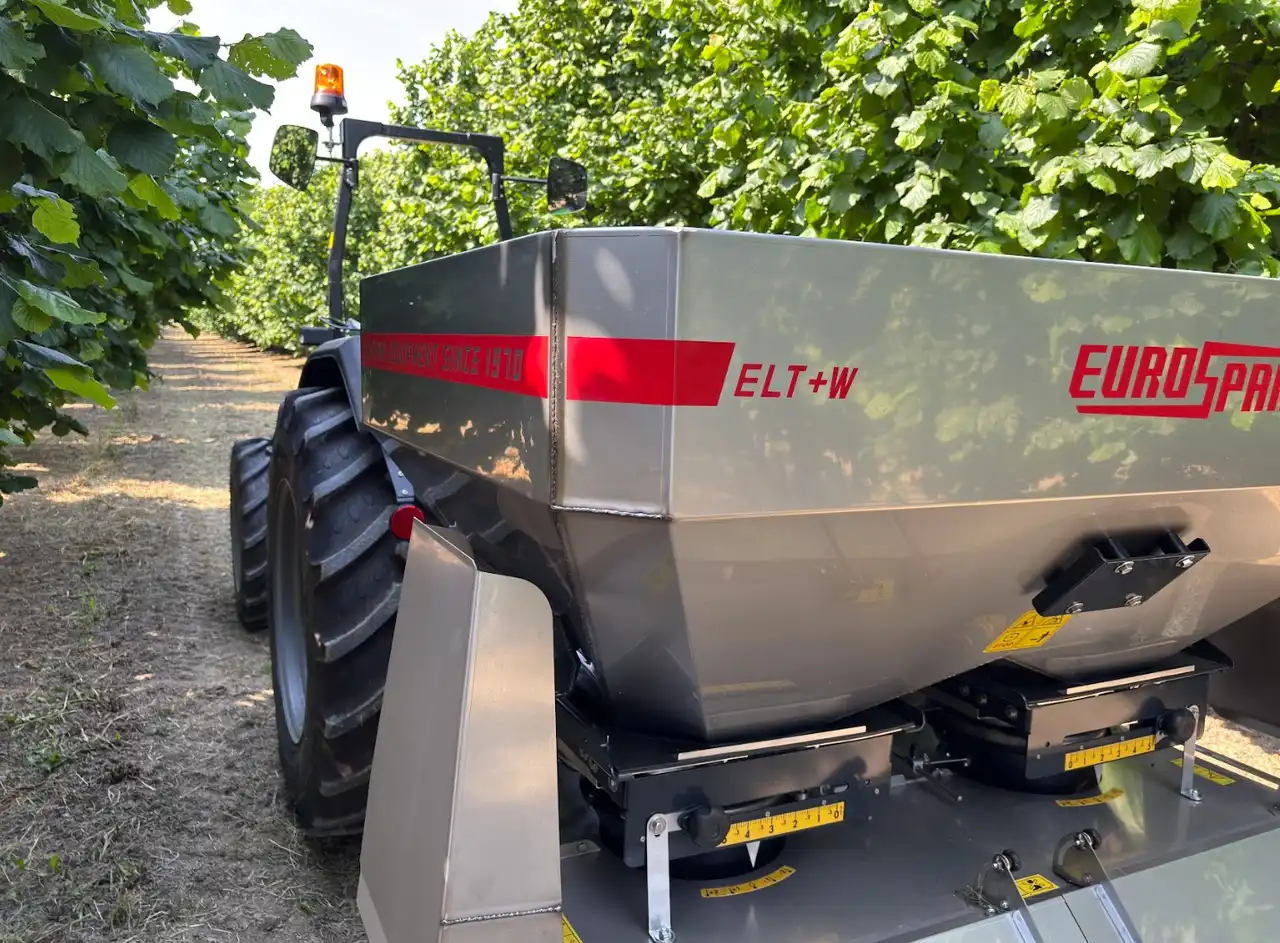
Anyone involved in agricultural machinery maintenance knows that the greatest threat to long-term durability is not just mechanical wear, but also chemical attack. In the fertilisation sector, this problem has a specific name: nitrates. Although essential for plant nutrition, nitrate-containing fertilisers can contribute to corrosion and are among the substances that require particular attention when in contact with metal equipment.
Choosing a stainless-steel hopper is neither an aesthetic luxury nor simply a matter of construction preference. It is an engineering decision that directly affects spreading consistency and the machine’s residual value over time. At Eurospand, chemical resistance is a fundamental design principle. That is why we use stainless steel not only for the hopper, but throughout the fertiliser contact chain: feeding systems, metering and spreading components, fasteners and hydraulic cylinders.
The chemistry of degradation: why nitrates attack steel
Ammonium nitrate, one of the most widely used fertilisers, is highly hygroscopic. This means it attracts moisture from the air, potentially creating an electrolyte solution on the machine’s surface. On ordinary carbon steel, even when painted, this solution can accelerate oxidation and corrosion.
Corrosion acts on two levels:
- Macroscopic: rust formation weakens the structure of the hopper and its supporting components.
- Microscopic: corrosion creates surface irregularities and microscopic defects that can compromise the material’s condition and encourage further deterioration.
AISI stainless steel: a passive barrier against corrosion
The corrosion resistance of the stainless steel used by Eurospand is based on a process known as passivation. A thin, invisible chromium oxide layer forms on the surface, helping protect the underlying metal from oxygen and corrosive agents.
This property is particularly important in metering areas, where fertiliser flows continuously and at speed. In a painted steel hopper, the constant friction of fertiliser granules—which can be abrasive—may gradually remove the paint layer. Once the underlying metal is exposed, corrosion can begin. Stainless steel, by contrast, benefits from a protective passive layer that can reform when the surface is scratched or abraded, provided the conditions are suitable.
Technical focus: the metering system and variable geometry
The precision of a Eurospand fertiliser spreader depends on the stability of its metering gates. Our machines use stainless steel metering components with variable-geometry openings.
If these components were affected by corrosion:
- The gates could become encrusted, making the fine opening and closing adjustments required by electronic control systems and precision farming difficult.
- Removing residues could become much more challenging, potentially requiring intensive washing procedures that could further damage other machine components.
Fasteners and components: don’t overlook the small details
A common mistake when assessing a machine is to focus only on the hopper. In maintenance, however, corroded bolts can become a major problem. A bolt securing a spreading disc or metering gate that has seized due to rust may require destructive removal methods, such as angle grinders or cutting torches, potentially damaging the machine.
Eurospand uses stainless steel fasteners throughout the machine. This means that, even after years of working with sulphates and nitrates, replacing a worn component or adjusting a spreading vane can remain a straightforward, quick and clean operation.
Stainless steel hopper maintenance: myths and facts
One point must be made clear: “stainless” does not mean indestructible or maintenance-free. Stainless steel resists corrosion, but fertiliser residues can still form deposits that interfere with subsequent operations.
For maintenance professionals, stainless steel offers important practical advantages:
- Quick cleaning: fertiliser residues are generally easier to remove from a smooth stainless steel surface, often with a water rinse when appropriate.
- No paint coating: there are no paint flakes to detach and contaminate the fertiliser or potentially obstruct outlet openings.
- Compatibility with suitable cleaning products: appropriate cleaning and descaling products can be used in accordance with the manufacturer’s instructions and the grade of stainless steel.
A stainless-steel hopper that is properly cleaned and dried at the end of the season will be ready for the next one without the need for repainting or anti-rust treatments, provided it has not suffered other forms of damage.
P1 = P2 and Vibro System: the connection with materials
As discussed in other contexts, Eurospand’s Vibro System relies on maintaining the flowability of the product. If the hopper walls were corroded and rough, the vibrating floor could have to overcome greater resistance to keep the fertiliser moving.
Stainless steel provides a smooth, durable surface that helps maintain consistent flow conditions. This supports the regular transfer of the pressure exerted by the fertiliser (P1) to the feeding system through to the final stages of hopper emptying (P2). Surface deterioration could, over time, affect the efficiency of the vibrating floor.
An investment in long-term productivity
In conclusion, the stainless-steel hopper and other stainless-steel components used by Eurospand provide a technical response to the challenges posed by fertilisers containing nitrates. It is not simply about preventing visible rust; it is about protecting the functional heart of the fertiliser spreader.
Choosing stainless steel for the hopper, metering components, spreading components and other critical parts helps to:
- Maintain precision: smooth surfaces support consistent product flow.
- Reduce maintenance costs: easier cleaning and no need for repainting due to paint deterioration.
- Protect resale value: a machine with stainless steel components may retain its market value better than an equivalent painted-steel machine, depending on its condition and specification.
- Maintain consistent gate operation: stainless steel linkages and joints help preserve reliable opening and discharge rates over time.
For professionals working in agriculture, machinery must be a reliable tool, not another problem to manage. Stainless steel helps turn this philosophy into practical performance.
To discover all Eurospand models available with an All-Stainless Steel configuration and explore the technical specifications of the metering components, visit our dedicated page at eurospand.com/en/stainless-steel or contact your local dealer.