


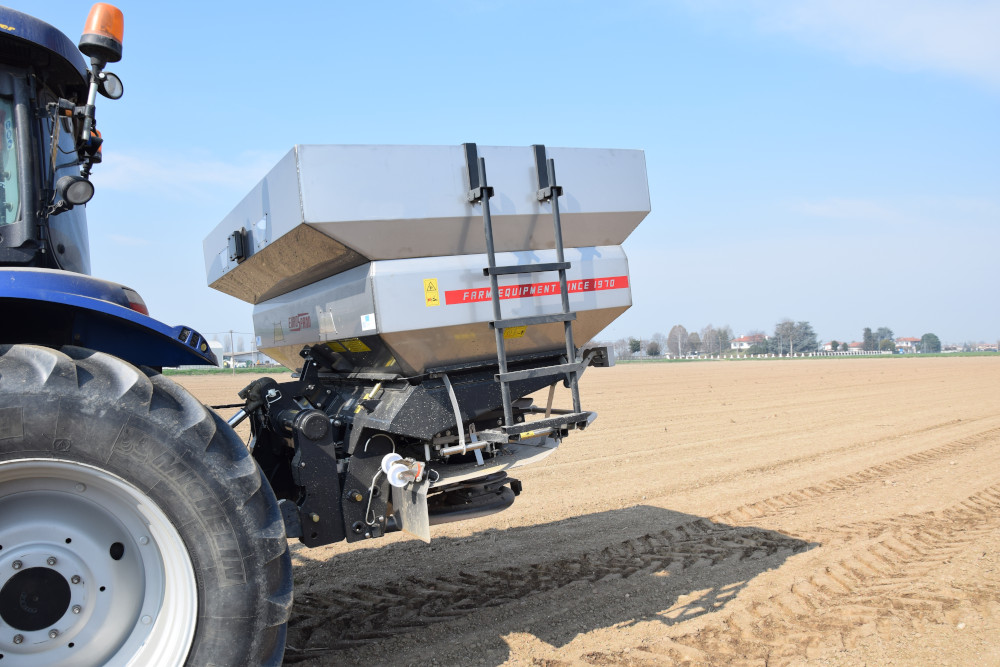
In the era of Agriculture 4.0, precision is no longer a futuristic vision, but an operational standard demanded by both the market and environmental regulations. However, there is a technical misunderstanding that often slows down the achievement of maximum efficiency: the confusion between “proportional application” and “actual measurement”.
For years, the DPA (Distance Proportional Application) system represented the pinnacle of technology. The logic is sound: adjust the opening of the shutters according to the tractor’s speed. If the machine accelerates, the system opens; if it slows down, it closes. However, as advanced as this system may be, it is based on estimation. In other words, it assumes that a given opening always corresponds to the same product flow rate.
In real field conditions, fertilizer is never a constant. Moisture, particle size and density vary not only between different batches, but often even within the same hopper. In this scenario, estimating is no longer enough: to achieve true 4.0 precision, measurement is essential. This is where Eurospand electronic weighing systems draw the line between those who “believe” they are spreading accurately and those who “know” they are.
The limitation of DPA: the “fertilizer” variable
The DPAE (electronic) system is a powerful ally, but it operates according to theoretical algorithms. If we load dry granular urea, the flow will be smooth. But what happens if the same product has absorbed moisture during storage? Or if we are spreading a pelleted organic fertilizer that tends to create friction?
In these cases, flowability decreases. The DPAE system will continue to open the shutter according to its programmed parameters, but the actual quantity of product passing through the outlet will be lower than the theoretical quantity.
Without a weighing system, the operator will only notice the error at the end of the field, when they realize that too much fertilizer remains (or that it has run out too soon). In precision agriculture, this error results in:
- Incorrect 4.0 data: The final report will indicate that the target application rate was distributed, while the physical reality is different.
- Incorrect application rate per hectare: The crop receives less or more nutrients than required.
The Eurospand solution: “+W” real-time weighing
Eurospand “+W” versions integrate a double-frame electronic weighing system that transforms the fertilizer spreader into a mobile laboratory. This is not simply a static weighing scale, but a dynamic system using 5,000 kg load cells.
These load cells continuously detect the actual variation in the weight of the product inside the hopper. The system does not “estimate” how much is being discharged: it measures it. If the fertilizer flows more slowly due to moisture, the weight sensor detects that the decrease in kilograms inside the hopper is lower than expected. Within seconds, the control unit instructs the superfast servomotors to open the shutter further, compensating for the reduced physical flowability.
This is true proportional application: a system that does not only consider the tractor’s speed, but translates every physical variation in the product into an application curve consistent with the exact required application rate per hectare.
The inclinometer: precision is not afraid of slopes
One of the historical challenges of weighing systems installed on agricultural machinery is the influence of slopes. On hilly terrain, the weight detected by the load cells can be distorted due to inclined force vectors.
Eurospand has solved this issue by integrating a control unit with an inclinometer. This device continuously detects the machine’s position and corrects the values measured by the load cells in real time. The system can compensate for inclinations of up to 12% in all directions.
Whether working on flat ground or on hilly terrain, the weight data remains objective. This is essential for companies operating in challenging geographical environments, where precision should not be a privilege reserved only for flat areas.
Electronic Synergy: Weighing, ISOBUS and Prescription Maps
Electronic weighing is at the heart of an integrated 4.0 ecosystem. When the machine is equipped with the ISOBUS protocol, the weight data communicates directly with the tractor’s Task Controller and with prescription maps.
- Total automation: The operator only has to drive; the machine takes care of speed, variable-rate application and physical verification of the weight.
- Prescription Maps: The map indicates that 250 kg/ha must be applied in a specific area.
- Actual weighing: The system verifies that the machine is actually reducing the hopper weight at a rate of 250 kg/ha, correcting the application instantly if the product is powdery or damp.
This level of control makes it possible to drastically reduce the coefficient of variation and ensure that every fertilizer granule reaches its correct agronomic destination.
Mechanics and Measurement: an inseparable combination
As we often say at Eurospand, electronics cannot perform miracles if the mechanics are not up to the task. The weighing system tells us “how much” product is being discharged, but it is the Vibro System that ensures smooth and consistent delivery.
Without a vibrating floor system, damp or pelleted products could descend intermittently or form agglomerations. The Vibro System ensures that the fertilizer reaches the dosing system smoothly, allowing the weighing system to work with linear data rather than sudden load peaks.
Furthermore, the use of stainless steel in the dosing and distribution components ensures that the shutters, operated by electric servomotors, do not encounter resistance caused by deposits or corrosion, responding instantly to the signals from the weighing system.
Verify, Don’t Just Automate
Agriculture 4.0 should not mean placing blind trust in technology. The real revolution lies in the ability to verify.
Being able to see the exact amount remaining in the hopper on the monitor, know how many kilograms are left until the end of the job, and have a final report based on actual weighing rather than mathematical estimates gives farmers an unprecedented level of management control.
Reducing the gap between the fertilizer purchased and the fertilizer actually applied means optimizing costs, protecting the environment and, ultimately, producing better.
A New Standard for Professional Agriculture
In conclusion, real-time weighing represents the necessary evolutionary step for anyone who wants to practice precision agriculture seriously.
Speed-proportional application systems (DPA) have taken the industry a major step forward, but today, given the variability of products and the need to maximize yields, physical control of the data is essential.
Eurospand “+W” versions, with their load-cell and inclinometer system, transform every field pass into an operation of absolute precision.
Measuring means having control; estimating means taking a risk. And in modern agriculture, risk is a luxury that no one can afford anymore.
To learn more about how our electronic weighing systems work and discover how to integrate +W technology into your machinery fleet, visit the dedicated section on eurospand.com or contact our specialized dealers for personalized technical advice.